
Cardboard and Bedsheets
No Longer, Not Yet by Marisol Valencia at the Art League Houston

For a long time, I wondered what is a proper way for art to respond to homelessness. Last year, the Houston neighborhood Midtown (where I live) hired several artists to create site specific installations along Milam Street addressing homelessness in the a collective project presented under the somewhat pandering name, HueMan: Shelter. When HueMan: Shelter went up, I went to each of the six sites, examined them closely, talked to the administrator behind the project, and started writing about it. I wanted to reflect on how these installations functioned as artworks. Was the intended audience the housed people, or Midtown’s homeless population (which I thought might be the case because of their locations—bus stops and the areas under freeway overpasses)? Did this installation have any effect on the material conditions of the homeless who live among the pieces along Milam Street, or did it serve an educational or purely esthetic purpose? I never finished my piece—I couldn’t resolve my feelings about how art should respond to homelessness.
Marisol Valencia’s approach was to work among homeless persons in a shelter serving migrant women and children for a year and a half. While there, they produced a spectacular piece of artwork through weekly crocheting sessions. This artwork is Encounters and it is on display in No longer, not yet, Valencia’s exhibit currently on view at the Art League. Encounters is a 30 foot long artwork made of ixtle fiber dyed a dark, intense blue.


Encounters dominates the Main Gallery at the Art League. The wall text explains that the length and size of the piece references the scale of the border walls along the US/Mexico border, but this metaphor feels strained. I would like to know what the women who crocheted this piece thought they were creating over the year and a half they worked on it—what did this labor mean to them? What were their names? Not crediting them places them within nameless, faceless categories like “homeless” or “migrants.” These anonymous collaborators are given respect in the literature that accompanies the exhibit, but not identified by name.
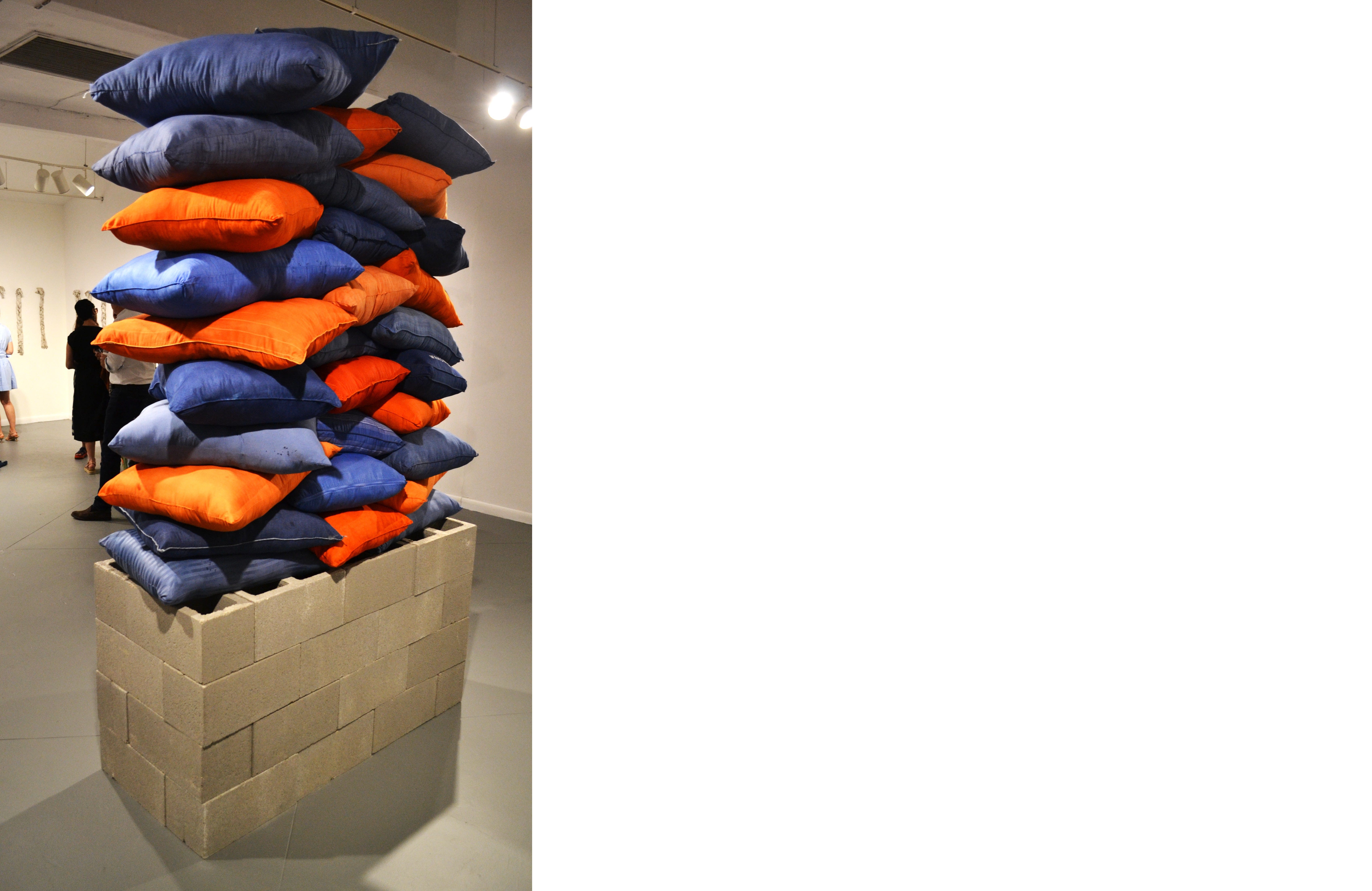
The American Dream is a pile of pillows stacked on top of a rectangular platform made of cinder blocks. The pillows come from the shelter where Valencia worked. Unlike Encounters, none of the materials in The American Dream have undergone any craft to change their appearance beyond being piled up very neatly. They are found objects, whose meaning in part comes from their origin and in part through purely symbolic associations. In the wall label for another piece, the relationship between cinder blocks and the labor of economic migrants is emphasized. Cinder blocks are used as display stands throughout the exhibit.
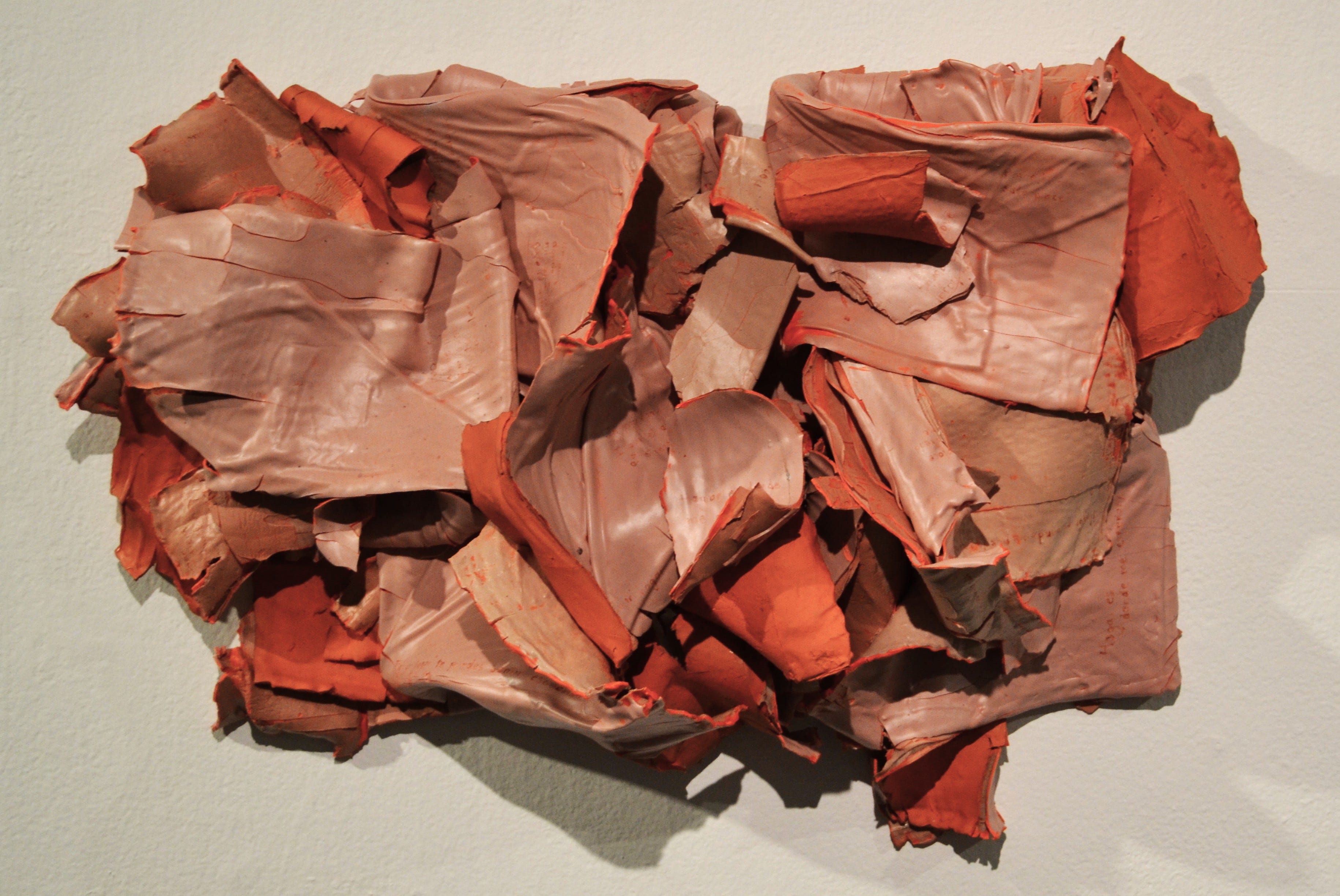
The artwork reproduced at the beginning of this post is Home in Another Form. Home in Another Form was made out of cardboard boxes dipped in porcelain slip and fired. There were several examples of this kind of object in the show, all with the same title. Not visible in the example above are phrases inscribed on the surface in response to a question posed to the residents of the shelter: what does a true home mean to you? The humbleness of cardboard is combined with gorgeous ceramic craftsmanship produces the kind of irony needed to turn a high-class white-wall gallery setting into a venue for reflecting on urgent social matters like mass migration.
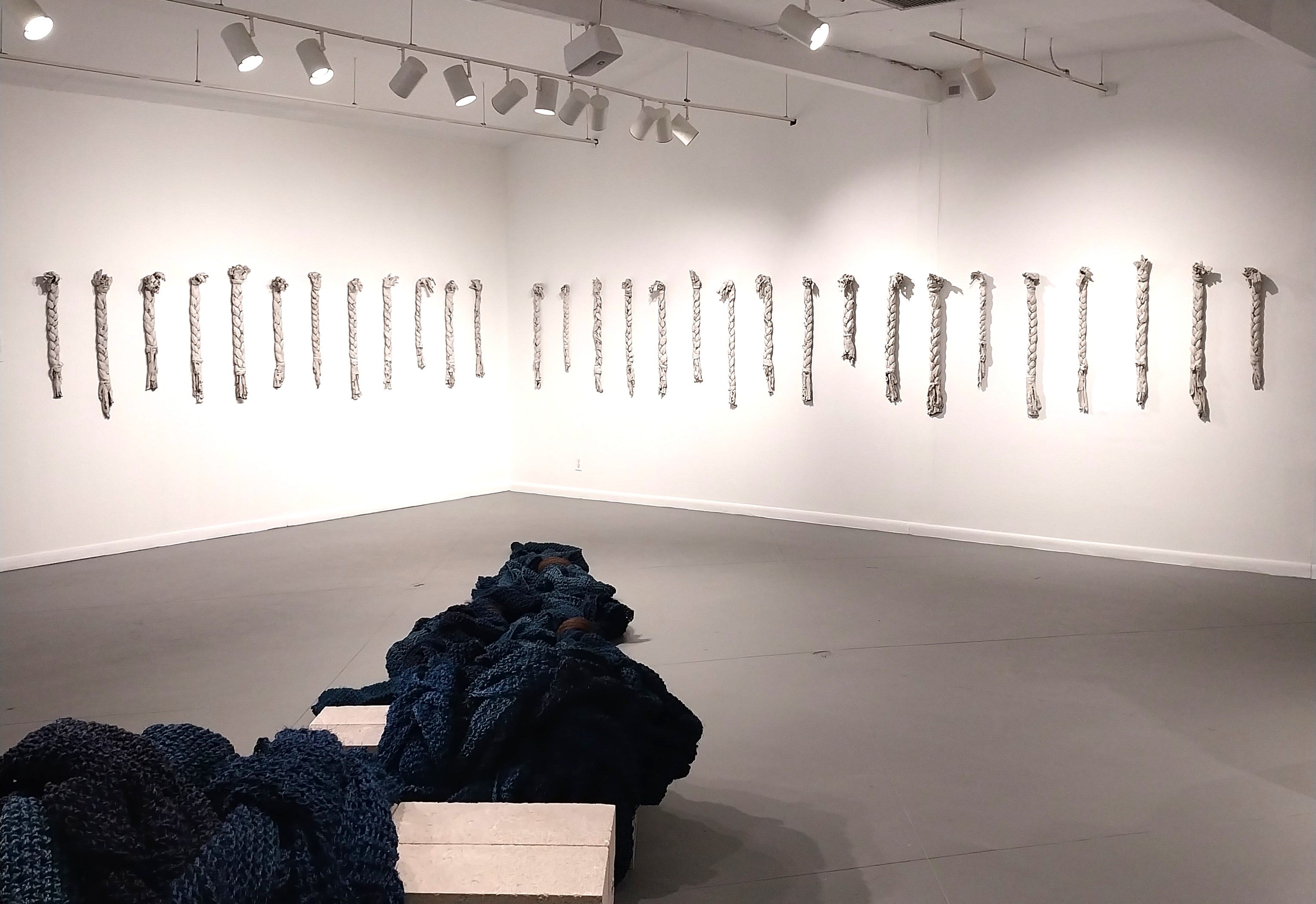
Valencia has mastered the technique of dipping something soft (like cardboard or cloth) into porcelain slip and firing it to produce a ceramic object. This technique was also employed in Precious Memories. Precious Memories was made from 30 bed sheets from the shelter that were torn into strips, braided, and fired. The end result is a series of ceramic objects, hung dramatically in a row along two of the walls of the main gallery of the Art League.
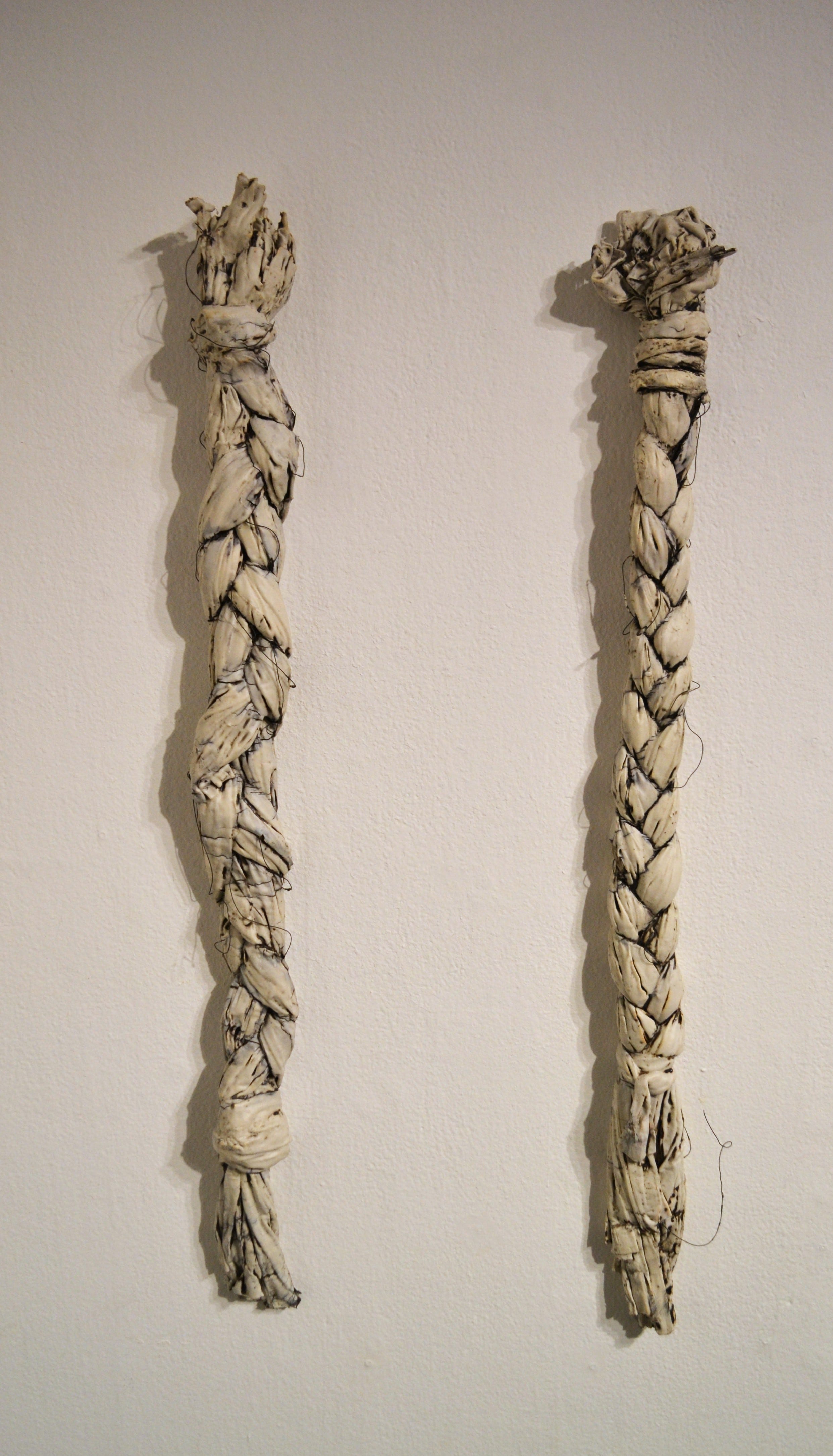
I am fascinated by the black shadow areas that appear in the wrinkles and folds. Is that intentional, or a by-product of the process employed to make the objects? I don’t know enough about the technique of dipping cloth in porcelain and firing it to be able to comment knowledgeably on it. Those black accents give the braids a worn, used feeling, which is a good reflection of their original use—to provide bedding for homeless migrant families.
No Longer, Not Yet by Marisol Valencia is on view at the Art League Houston through July 19.
Furthermore, I am of the opinion that for the good of America, Jeffrey Epstein’s best friend Donald Trump must release everything related to the Epstein case (unredacted), disband ICE, and resign.
[Please consider supporting this publication by subscribing, by becoming a patron, or you can also support it by patronizing our online store.]
Thanks, I'll likely visit.
How big is the first piece?