
ELPASO
A Punk Story

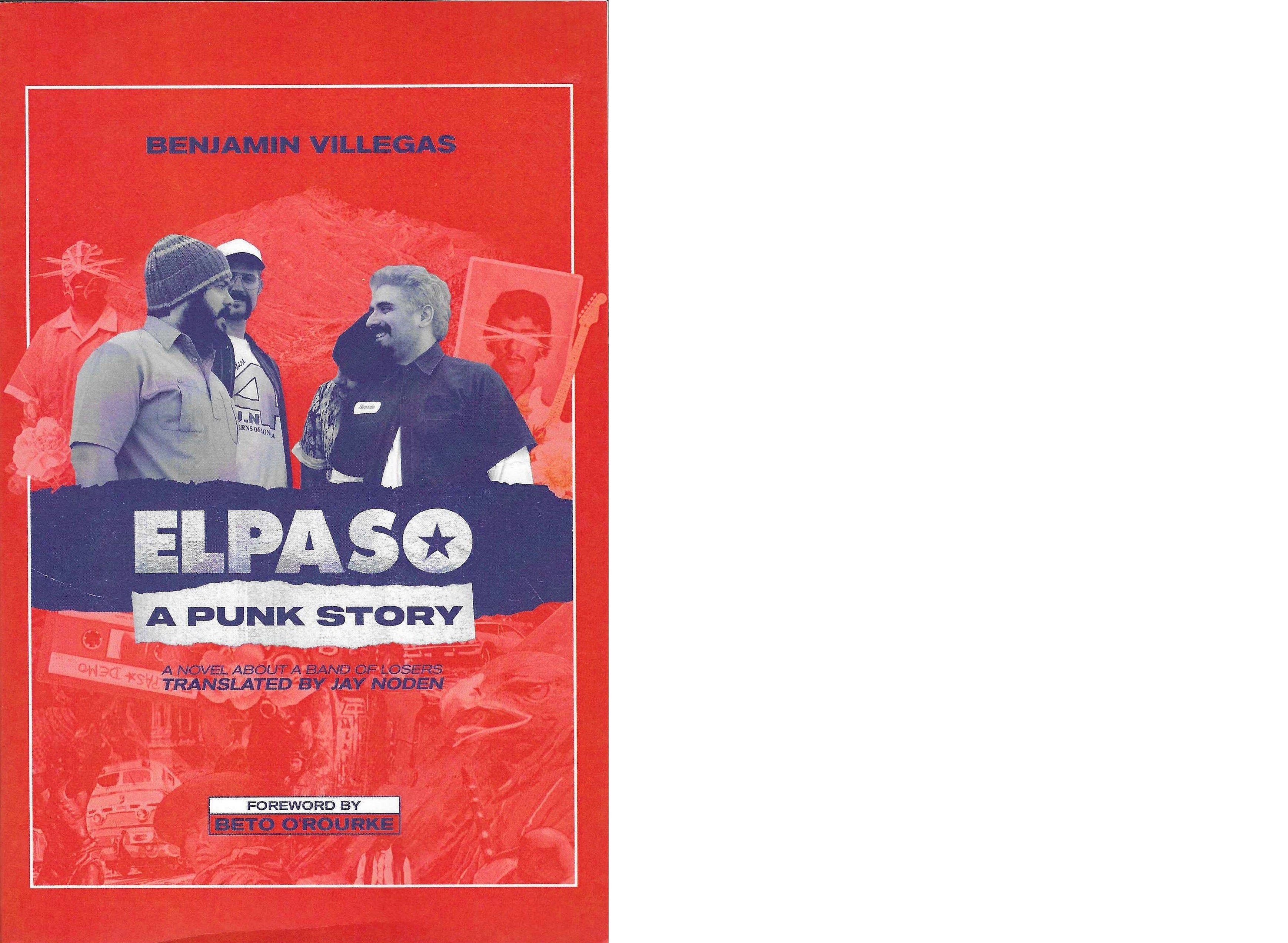
Continuing in my series of books about punk rock music and Texas, let us take a look at ELPASO: A Punk Story, a novel about a fictional El Paso punk band. “Punk rock and Texas” feels like an inherently limited literary genre—I was a little surprised to discover ELPASO, which is the third book in this genre that I have stumbled across recently. Unlike Pat Blashill’s two recent Texas/punk books, ELPASO is a novel. The author, Benjamin Villegas, is from Spain and had never been to El Paso when he started writing ELPASO. He knew he liked some punk bands from Texas and wanted to set his novel about a band there. He wanted his fictional band to sing their punk songs in Spanish and decided that El Paso seemed like a reasonable small city from which such a band could arise. This information comes from a 2021 article that ran in the Dallas Observer, “Benjamin Villegas Writes About Punk Band that Never Existed in a Scene That Did.” While I can’t testify about how well Villegas describes the El Paso rock scene of the 80s, his research into the music scenes of other Texas cities is accurate and somewhat surprising for an outsider to have dug up. Given how spot on he is about aspects of the Austin and Houston punk worlds, I suspect his depiction of El Paso is equally well-researched.
In the early eighties, a group of high-school-aged friends in El Paso have discovered punk and new wave music. Teenage Popeye, a non-fictional El Paso punk band that existed in the early eighties, was Ritchie Salazar’s entry into the local music scene. He met kids in his high school who had similar interests, such as the artistically talented Daniel, with whom he produced a fanzine influenced by their favorite comic book, Love and Rockets. They named their zine Rock & Lovets in homage. Love and Rockets is a perfect comic to inspire them as it was the product of three Chicano punk rockers. Daniel studied art at UT after high school, and discovered the comic there.
Daniel being in Austin during college allowed him to sample the other punk and new wave scenes that popped up around Texas at the time. He fell in love with The Judy’s, a somewhat Devo-like band from Houston that was locally popular in the early 80s. (I saw them many times, including opening for the B-52s in Austin—a concert that I imagine that the fictional Daniel also attended.) The Judy’s biggest “hit” was a darkly ironic song called “Guyana Punch,” which made pitiless fun of the mass murder/suicide by the members of Jim Jones’ Peoples Temple.
Daniel and Ritchie gradually recruit a small cohort of fellow punk rock enthusiasts to form a band. Daniel came up with a name for the band after creating advertisements promoting El Paso as an assignment for a design class. He joined the two words “El” and “Paso” in big all caps Futura Bold—ELPASO. That becomes the name of the band.
Their gimmick was that they performed several well-known punk and new wave songs in Spanish to express their Chicano identity. Their initial playlist were Spanish covers of
“Guyana Punch” by the Judy’s
“Rise Above” by Black Flag
“Sheena is a Punk Rocker” by the Ramones
“Never Talking to You Again” by Hüsker Dü
“Venus” by Television
All of which are punk rock classics. That said, no one considered “Guyana Punch” to be a “punk” song when it was released in 1981. It was “punk” in terms of being snotty and anti-social, not in the sense of loud fast riffage. The band began rehearsing in a garage in El Paso, with Daniel on the drums. At this point, being a real band was still something of a fantasy, but they were filled with teenage energy.
As the band gradually added band members with actual musical chops, it became clear that Daniel’s part in the band was destined to be something non-musical. He became the band’s graphic artist, publicist, and general manager. The book includes a series of Daniel’s flyers and zine covers as part of the text. In 1986, they undertook a small tour of Texas, hitting Fort Worth, Austin, and San Antonio as well as a couple of college town stops, Dennison and Alpine. Villegas has them skip Houston, which will become an important setting later.
The band recorded its first EP called Gimme These Songs! in 1987, featuring Spanish-language covers of songs by the Judy’s, Black Flag, Hüsker Dü, and Mission of Burma. This was the high point of their “career,” after which the band started to slowly wither. Two of the members thought about moving to Houston and starting a new band there. A friend of theirs in Houston puts them in contact with J.R., who ran a rock club called The Axiom. J.R. is a real person, J.R. Delgado, and the Axiom was a popular late 80s alternative Houston music club just east of downtown. ELPASO polished its punk bona fides by including a variety of real life figures from the world of Texas punk rock into the story. In addition to Delgado, there are appearances by Tim Kerr and Beto O’Rourke who was in an El Paso band called Stinging Fish before becoming a Congressman. (O’Rourke wrote a forward to ELPASO: A Punk Story.)
The show at the Axiom was so poorly attended and dispiriting that Ritchie had a debilitating panic attack and fainted on stage. After they returned to El Paso, one of the band members died in a car accident, and subsequently ELPASO sputtered out.
ELPASO includes a bunch of illustrations—band photos, show flyers, the covers of zines, the kind of ephemera that a fan of a band would keep in a scrapbook. At the end of the book is a detailed list of the 27 shows ELPASO played over their short life. With this extra content. ELPASO less like a novel than an elaborate fanzine. It is an interesting experiment—but calling in an experiment seems like I am suggesting that ELPASO was a challenge to read. Far from it—Villegas’ style is fanzine lite. It doesn’t challenge the reader—it submerges the reader in a bath of punk nostalgia.

Furthermore, I am of the opinion that for the good of America, Trump must release everything related to the Epstein case (unredacted), disband ICE, and resign.
[Please consider supporting this publication by becoming a patron, and you can also support it by patronizing our online store. And one more way to support this work is to buy books through The Great God Pan is Dead’s bookstore. ]
The whole punk attitude and aesthetic was as distinctive as what went on in San Francisco in the '60s, with a grittier vibe. Too bad these guys didn't last any longer than they did, because they had the right spirit, and with time, could've emerged as something. But for the time they were around, they sounded great, fun, and authentically what rock 'n' roll as a whole needs to be.
This sounds pretty great and since my formative years weren't in Houston, I would probably enjoy the punk education.